
Imagine a medical mystery that sounds like a riddle. There is a serious, debilitating mental health condition that affects about 1 in every 100 people all over the world. It does not care how old you are, where you live, or what you eat. Scientists see it everywhere, in every culture and every country. This condition is called schizophrenia.
But here is the twist: even though it is so common, there is one group of people who appear to never get it. No person born with cortical blindness has ever been diagnosed with schizophrenia.
This is a huge deal in the world of science. It is like finding a shield that protects some people from a very difficult illness. If we can understand how this shield works, we might learn how to help everyone else. Let’s dive into why this happens and what it tells us about our amazing brains.
Are you blind or visually impaired or do you know someone who is? Visit our homepage at blindaccessibilitytips.com to find out what our website has to offer, including a free course teaching individuals with vision loss how to use their computers.
The Great Discovery
For a long time, doctors noticed that they never seemed to meet a patient who was both born with cortical blindness and had schizophrenia. At first, they thought it might just be a coincidence. But as decades went by, the pattern stayed the same.
Researchers decided to look at the numbers properly. In one landmark study in Australia, scientists tracked almost 468,000 children born between 1980 and 2001. Out of all those children, about 0.4% developed schizophrenia or similar illnesses. However, among the 66 children who were born with cortical blindness, where the brain’s visual cortex cannot process images, there were zero cases of schizophrenia.
You can read the full details of this study on PubMed.
That “zero” is what makes scientists so excited. It suggests that something happens in the brain of a cortically blind baby that protects them for the rest of their life. But to understand why, we first have to understand how a typical brain works.
It is also worth noting that while this pattern has now held across more than 70 years of research and multiple population studies, scientists are still working to fully confirm it; a definitive study would require an enormous population sample. The evidence is compelling, but the research is ongoing.
Your Brain Is a Fortune Teller
Most of us think our brains are like cameras. We think our eyes take a picture of the world, and our brain just looks at it. But science tells us that is not true at all.
Your brain is actually a prediction machine. It is more like a weather forecaster than a camera. It does not wait for information to arrive; it guesses what is about to happen based on what has happened before.
For example, think about the phone or computer you are using right now. Your brain already knows what it feels like, what it looks like, and what sounds it makes. Before the signals from your hand even reach your head, your brain has already built a mental “model” or “forecast” of that object.
When the real information arrives, your brain compares it to its guess. If they match, everything is fine and you do not even notice. But if there is a mismatch, like if your phone suddenly felt like a cold piece of ice, your brain fires an “error signal.” This tells you to pay attention because something unexpected is happening.
The “Glitch” in Schizophrenia
In a person with schizophrenia, this prediction system has a glitch. This is often described as a failure in predictive coding.
Inside their brain, the “error signals” fire when they should not. The brain’s forecaster starts making wrong guesses and then insists those guesses are real. This is what leads to hallucinations (seeing or hearing things that are not there) and delusions (believing things that are not true). Their brain essentially keeps “updating” its model of the world based on mistakes, making them perceive a reality that does not exist.
You can learn more about how predictive coding relates to psychosis in this Frontiers in Psychology research paper, which explores the cognitive and neuroplasticity mechanisms involved.
Why Cortical Blindness Acts as a Shield
So, why does being born with cortical blindness stop this from happening?
The theory is quite simple but very profound. If the brain’s visual cortex has never received visual input, it never builds a visual predictive model in the first place. Since there is no visual “forecast” being made, there is no forecast to go wrong.
Think of it like a software programme. If you never install the “Vision 1.0” software, that software can never catch a virus or crash. Because cortically blind people rely entirely on their other senses from day one, their brains develop in a very different and remarkably stable way.
Super-Senses and Brain Power
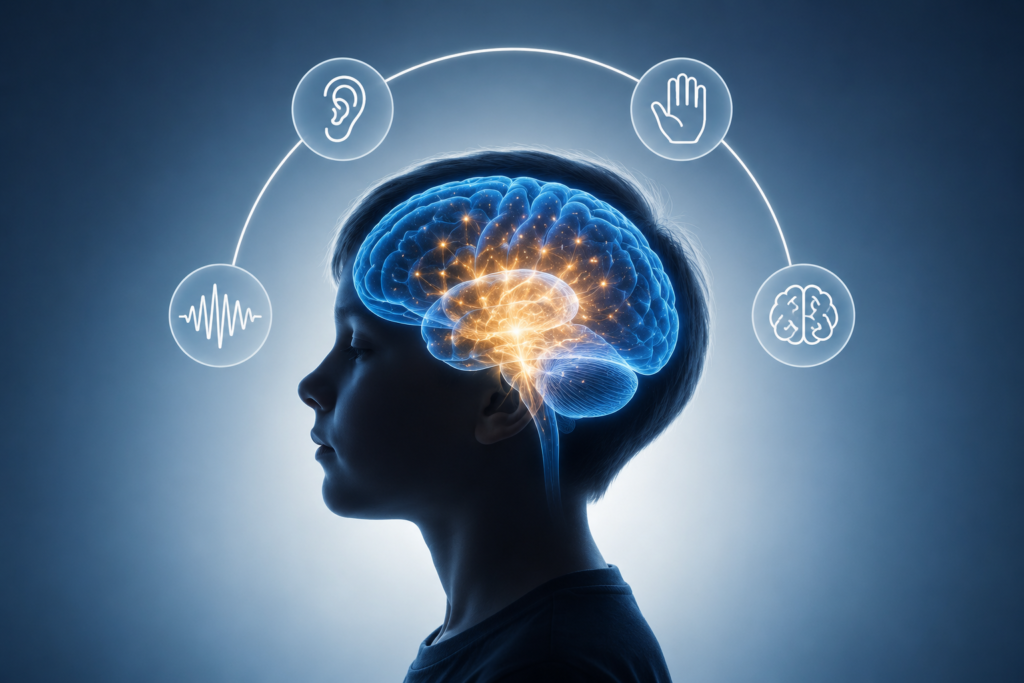
When a baby is born with cortical blindness, the part of the brain normally used for processing sight does not simply sit idle. Instead, the brain is extraordinarily adaptable and repurposes that area. This process is called neuroplasticity.
The brain recycles the visual cortex and uses it to enhance sound, touch, and even language processing. This is why people who are born with cortical blindness often develop:
- Superior hearing and auditory memory
- Better attention and focus
- A very strong capacity for organising information mentally
Because they must rely so heavily on touch and sound, their mental model of the world is built with great care. It is solid and robust. In schizophrenia, the brain is often “too flexible” in a harmful way — it changes its interpretation of reality too easily. But a cortically blind person’s brain builds a model that is more stable and reliable, which appears to keep psychosis at bay.
You can explore this neuroplasticity research in more detail in this PMC paper on cognitive and neuroplasticity mechanisms in congenital blindness.
Not All Blindness Provides This Protection
This is one of the most important distinctions in the research, and it is worth being very clear about.
The “shield” only applies to cortical blindness — where the brain’s visual processing centre itself is not functioning. If someone is blind because of damage to the eyes (called peripheral blindness) while the visual cortex remains intact, the protection does not appear to work in the same way.
Equally, if someone loses their sight as an adult, they do not get this protection. In fact, losing vision later in life can actually increase the risk of hallucinations. An adult’s brain has already spent years building a detailed visual model of the world. When the eyes stop sending data, the brain’s forecaster keeps trying to work anyway — like a radio desperately searching for a signal, it may start producing “ghost” images because it is starved for information.
Also of note: being born deaf does not protect against schizophrenia in the same way. This tells us that vision specifically plays a unique and powerful role in how our brains learn to construct and interpret reality.
What This Means for the Future
This discovery is more than just a fascinating scientific curiosity. It is a roadmap for future medicine. If vision is a key factor in the development of schizophrenia, then scientists can look for ways to strengthen the brain’s prediction system in sighted people.
Right now, researchers are studying how small distortions in visual perception might serve as early warning signs of mental illness. If these subtle glitches can be caught early, it may be possible to address the brain’s faulty forecasting system before more serious symptoms develop. That could mean earlier intervention, better outcomes, and new treatment approaches that go far beyond what current medications can offer.
A Quick Summary
Here is what the science tells us:
- Schizophrenia is a condition where the brain’s prediction system breaks down, leading to hallucinations and delusions.
- No person born with cortical blindness has ever been found to have schizophrenia — a pattern that has held across more than 70 years of research.
- The protective effect works because a brain that never receives visual input never builds the visual predictive models that appear to malfunction in schizophrenia.
- Neuroplasticity allows the brain to repurpose the visual cortex for other functions, creating a more stable and reliable mental model of the world.
- This protection is specific to cortical blindness — not all blindness, and not blindness acquired later in life.
It is remarkable to think that by studying what the brain cannot do, we are learning some of its deepest secrets. Sometimes, never seeing the world at all is the very thing that keeps a person’s world from falling apart.
For more material for blind and visually impaired persons, go to our homepage at blindaccessibilitytips.com.
Sources and Further Reading
Morgan, V.A. et al. (2018). Congenital blindness is protective for schizophrenia and other psychotic illness: A whole-population study. Schizophrenia Research. Read on PubMed
Silverstein, S.M., Wang, Y., & Keane, B.P. (2012). Cognitive and neuroplasticity mechanisms by which congenital or early blindness may confer a protective effect against schizophrenia. Frontiers in Psychology. Read on PMC
Silverstein, S.M. & Roché, M.W. (2013). Base rates, blindness, and schizophrenia. Frontiers in Psychology. Read the article
Silverstein, S.M. et al. (2012). Neuroplasticity and predictive coding in blindness and schizophrenia. Frontiers in Psychology. Read the article
Landgraf, S. & Osterheider, M. (2013). “To see or not to see”: The Protection-Against-Schizophrenia (PaSZ) model. Frontiers in Psychology. Read the article
Psychology Today. Why Early Blindness Prevents Schizophrenia. Read the article